

Interview Transcript: Sayonara Wild Hearts’ Simon Flesser, March 2025
For Retro Gamer Magazine (#276), I interviewed Sayonara Wild Hearts' director Simon Flesser. We talked about Simogo's musical arcade mashup, and why it's destined to be a future classic.
Here’s the mostly unedited transcript of that conversation.
James Tocchio: Can you describe the first spark of an idea that eventually lead to Sayonara Wild Hearts?
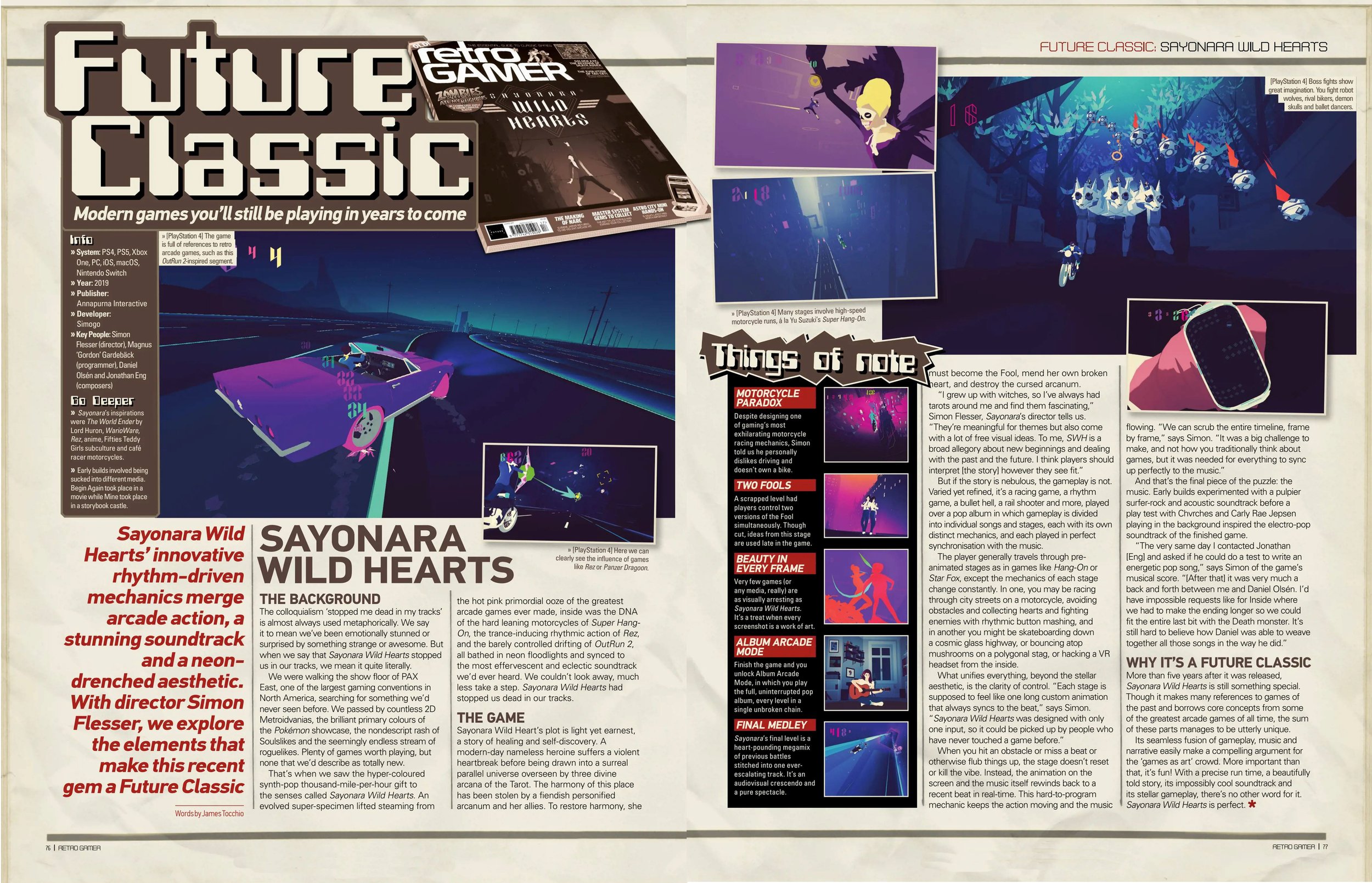
Simon Flesser: Listening to the Lord Huron song “World Ender,” I had a vision of a game of a masked avenger on a motorcycle. At the same time I had started drawing characters inspired by the teddy girl culture, wearing masks. These were the two first real sparks that ignited the idea.
James Tocchio: Prior to Sayonara Wild Hearts, Simogo’s best-known projects had been puzzle games, and your latest was another excellent puzzle game called Lorelei and the Laser Eyes. Do genre labels matter to you, or do you see your creative identity as fluid and transcending traditional categories?
Simon Flesser: I guess genres are useful for trying to explain a game to a potential audience, but we don’t really make strict genre games, and don’t have an interest in specific genres in a traditional sense. Perhaps more on the contrary, we’re interested in exploring things that we think we can push in other directions than they usually do. That could be things like trying to have more moment-to-moment gameplay in text based games, or puzzle games, or trying to find ways to simplify action games while not compromising on the sensation of spectacle, like Sayonara Wild Hearts.
James Tocchio: I’m a Sega fan, and when playing Sayonara, I was constantly feeling the influence of some of my favorite games, including OutRun, Super Hang-On, Rez, even Panzer Dragoon and Space Harrier. Can you confirm that you’re Sega freaks like me? Could you elaborate on how these influences shaped the gameplay and whether there are additional inspirations that played a key role in its development?
Simon Flesser: We grew up with mainly Nintendo and Amiga, but it’s definitely a correct observation that SWH has some very strong SEGA influences. In later years I’ve come to really love specifically OutRun 2, but like everyone else I also like Rez.
James Tocchio: What’s the most interesting video game you’ve played in the last year, and what elements of that game resonated with you?
Simon Flesser: I’m not too keen on new games, but in the last year it would have to be Animal Well, and Emio - The Smiling Man: Famicom Detective Club. The first one for its great sense of mystery and the second for its humanity and surprising themes for a Nintendo game.
James Tocchio: Beyond video games, are there specific films, musical genres, or visual arts that have recently inspired your design choices?
Simon Flesser: Video games as a culture overall, anime, the Teddy Girls subculture and the cafe racer subculture [were influential when making Sayonara].
James Tocchio: The cafe racer influence is right at the forefront, and as a motorcycle builder and rider myself, I can tell you that the game does well to provide the feeling of racing a motorcycle. Are you motorcyclists?
Simon Flesser: I personally don’t like motor vehicles in real life, as I’m kind of nervous about traffic overall, but I love the sensation of speed, especially in games. I don’t even drive a car, but Gordon [the game’s co-creator] drives and owns a motorcycle.
James Tocchio: Sayonara Wild Hearts tells its story with deliberate minimalism, leaving much open to interpretation. How do you approach storytelling, and what do you hope players discover in its ambiguity?
Simon Flesser: To me, SWH is a broad allegory about new beginnings and dealing with the past and the future. I think players should interpret it however they see fit. It was never meant to be about about something specific or concrete, for that reason. I think the entire idea with an ambiguous story is that it is open for interpretation and so I don’t want to force my exact ideas about what the story means.
James Tocchio: I love games which feature a simple core concept, refined and perfected, however many of today’s most popular games feature hours long on-boarding just to teach us how to play the game. I struggle to enjoy this, especially as I get older.
Sayonara Wild Hearts launches into its gameplay after a brief cinematic. There is no onboarding or tutorial. We’re simply dropped into a magical rollercoaster of light and sound and intuitively know what to do, which I consider the result of intelligent game design. Your latest game, Lorelei, is more complex, but relatively speaking it is similarly refined.
What are your thoughts (broadly or specifically) on game design related to complexity vs simplicity? How do you approach the balance between simplicity and complexity in game design, especially when considering player onboarding and intuitive play?
Simon Flesser: Both Lorelei and the Laser Eyes and Sayonara Wild Hearts were designed with only one input, so that they could be picked up by people who have never touched a game before. Both were designed to be complex in different ways.
Generally I think the best way for teaching the player is to just have them learning by doing, in non-threatening circumstances.
James Tocchio: Where does the tarot card influence in Sayonara Wild Hearts come from, and what does it symbolize within the game?
Simon Flesser: I grew up with witches so I have always had tarots around me and find them fascinating. They’re meaningful for themes, but also come with a lot of free visual ideas.
James Tocchio: The development of Sayonara Wild Hearts took four or five years and involved a larger team of creatives than previous Simogo projects. Could you discuss how you and your team managed creative differences to produce a unified artistic vision?
Simon Flesser: I guess you need a strong vision, and that takes a while to take shape. So it was a lot of iteration until we understood what Sayonara Wild Hearts was and what would fit and not. As more ideas come together, it gets easier and easier to understand what fits and what the game needs. We cut a lot of content to get there.
James Tocchio: What are Simogo’s favorite snacks?
Simon Flesser: As we get older we have to be mindful about snacks! We’re all big enjoyers of coffee, but I don’t think there’s a unified opinion about snacks. In fact, I don’t think we snack that much.
James Tocchio: SWH is a pop album, a game, a piece of digital art, and it must have been difficult to combine all its elements into one cohesive experience. Can you share a specific moment during development when art, music, and programming converged into a breakthrough moment?
Simon Flesser: I [originally] had an idea about a much grittier and pulpier game, but when playing a rough prototype of driving with The Fool in the night as playlist of pop music with things like Robyn, CHVRCHES and Carly Rae Jepsen came in, the entire idea about the game shifted from one day to another. The very same day I contacted Jonathan and asked if he could do a test to write an energetic pop song.
James Tocchio: Did you experiment with any unconventional gameplay mechanics that ultimately didn’t make the final cut?
Simon Flesser: There were a ton of things we cut from the game, often because we deemed them too complex or that they slowed the game down. We had story bits in third person in which you’d walk around, between songs. At that time we imagined the game only being the main lyric pop songs, but instead opted for many small levels that could explore smaller ideas instead. In this concept the Fool would get sucked into different medias, and ‘Begin Again’ took place inside a movie, while ‘Mine’ took place in storybook castle.
We had ideas about The Fool learning and using a new skill for each main song. One of these was splitting herself in two, and you’d control two Fools on the stage, sometimes on splitting tracks. We had an almost finished level with this, which was fight against The Stereo Lovers in a castle. Some of these concepts would survive in different shapes and you can see parts that are inspired by this in final Stereo Lovers levels.
James Tocchio: I have read that the development of SWH was quite challenging and stressful. What were some of the most significant challenges you encountered during the four or five years of developing Sayonara Wild Hearts, and how did those experiences shape the final product?
Simon Flesser: While we did create a lot of systems, we didn’t create enough tools to interact with them, so work often became laborious and slow, which led to frustration and stress. We wanted to make a game that constantly shifted and that felt custom all the time, so for a lot of the time it wasn’t even possible to systemize things within the game.
Each stage is built like and was supposed to feel like one long custom animation that always syncs to the beat, and that idea in itself was perhaps too much for a small team like us to handle.
James Tocchio: Game development can be intense and demanding. What strategies do you employ to maintain creative momentum and avoid burnout during long development cycles?
Simon Flesser: Finding ways to keep the development joyful every day. The best way for this is to design games and tools that allows for a lot of progress constantly, even in a big project. It’s also important to highlight progress to everyone on the team, so that everyone sees and understands that we are always moving forwards together. In that respect, Lorelei and the Laser Eyes was a much better project for us.
James Tocchio: The identity of SWH is inextricably linked to its soundtrack, which is a sort of energetic electro-pop album bursting with emotion.
Jonathan Eng’s early tracks leaned towards an electric guitar, California surfer, garage rock vibe. What drove the shift towards the electro-pop sound that defines the final version of Sayonara Wild Hearts?
Simon Flesser: I mentioned a defining moment before, but part of this was also to give the game a more feminine image and feeling, which would make the game unique from games which are often very masculine and macho.
James Tocchio: Could you share how the process of creating and integrating the soundtrack was interwoven with game programming and design decisions?
Simon Flesser: Typically, we’d have a sketch for song, or a more or less finished song, that I’d write a scenario for, and then making more and more edits along the way.
James Tocchio: Did the soundtrack come first, influencing the gameplay mechanics, or was it an iterative process where music and gameplay evolved together?
Simon Flesser: It was very much a back and forth between me and Daniel Olsén. Sometimes I’d have an idea for a level, and I’d come with a request to Daniel like ‘This one needs the snare and base drum to be specifically clear and be closer to a hip hop song in tempo, as we are shifting dimensions on the beats.’ Other times, we would have more finished songs, and I’d have impossible requests like for ‘Inside’ where we had to make the ending longer so we could fit the entire last bit with the Death monster. The most impossible request was the last level medley, and it’s still hard to believe how Daniel was able to weave together all those songs in the way he did, while constantly changing to fit requests about lenght and intensity.
James Tocchio: Could you elaborate on the challenges of designing gameplay that is so tightly integrated with the music, for instance, the rewind mechanic during fail states?
Simon Flesser: Basically the entire game is built like an animation, and when designing them we can scrub the entire timeline, frame by frame. It was a big challenge to make, and not how you traditionally think about games. But it was needed, as everything needed to sync up perfectly to the music.
We did for a long time have mechanics that were tied to this, which involved slowing down time, something very reminiscent of bullet time mechanics seen in other games and movies. We’d have one dreamy time stretch version of each song, and when you held down the button you’d consume a meter that made the level slower, but the character would still control as fast.
James Tocchio: What are your favorite game soundtracks?
Simon Flesser: Both me and Daniel love the WarioWare soundtracks and often call tracks ‘Dr. Crygor-like’ if it has a specific vibe.
I generally like most songs from Hip Tanaka. I love the soundtrack to Space Invaders Infinity Gene. I also quite like Silent Hill 2’s soundtrack. But I think Yoshi’s Island is my all time favorite.
James Tocchio: What does ‘success’ look like for you, not just commercially, but artistically?
Simon Flesser: If a game realizes its idea, and does what it sets out to do, it is a success.
James Tocchio: Do you think you’ll create a follow-up to Sayonara Wild Hearts?
Simon Flesser: No. But it was fun to revisit and finalise Remix Arcade with the new PS5 version.
James Tocchio: Can you share any hints about future projects from Simogo?
Simon Flesser: In the nearest future it’s about looking to the past before we move along to the future.