

Interview Transcript: Richard Jacques, August 2025
In 2022, I launched a Dreamcast-focused website and Youtube channel. This silly passion project ended up opening some interesting doors, including the opportunity to work as localization editor on a particularly neat game translation project, and the chance to appear in the pages of Retro Gamer Magazine.
This latter event came about because the December 2023 issue of (Retro Gamer #254) was to feature a cover story written by Nick Thorpe focused on Sega’s final home console. Being familiar with my Dreamcast content, Nick reached out to me as a source.
I guess he liked my writing well enough that at the end of our conversation, he suggested I pitch to the magazine, which I did.
A few weeks later, I spoke with Richard Jacques, the well-known composer of such game soundtracks as Sonic R, Marvel’s Guardians of the Galaxy, and Mass Effect. We had a great conversation, and the content of that interview became an “In the Chair” feature article in the March 2024 issue of Retro Gamer (#257).
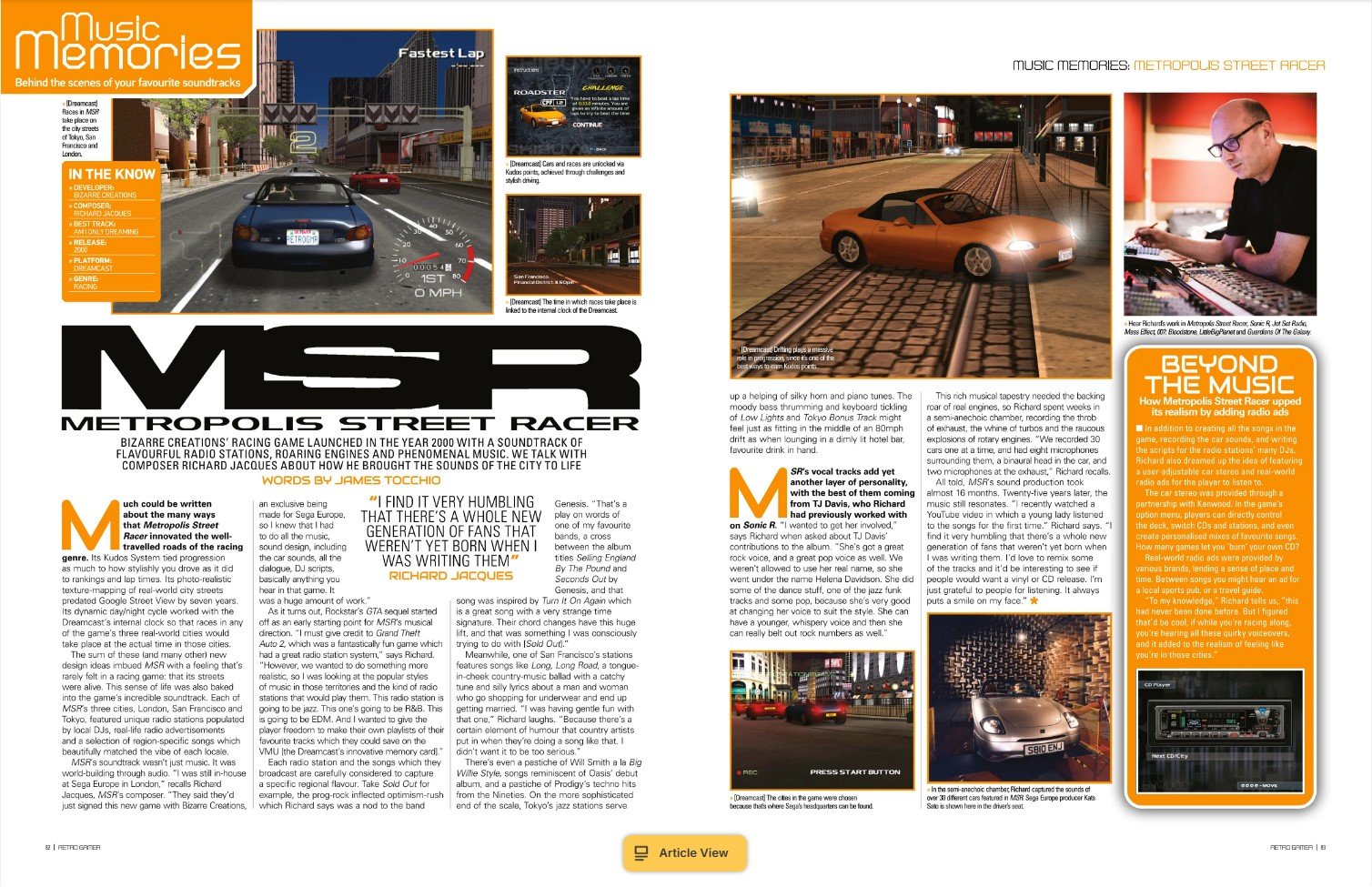
A while later, and with about ten issues of RG under my freelance belt, I was asked to write an article for the magazine’s recurring “Music Memories” feature. In this feature, the magazine spotlights a game with a phenomenal soundtrack, often with interview content from the composer or musician who created it. I chose Metropolis Street Racer, Bizarre Creations’ groundbreaking Sega Dreamcast racing game, and I once again spoke with Richard Jacques, who composed the game’s music and created the game’s sound effects.
That article appears in the September 2025 issue of Retro Gamer (#277). As is always the case, the interview included much which could not fit in the magazine. Here’s the mostly unedited transcript of my conversation with Richard.
James Tocchio: Please introduce yourself and give us a very brief list of some of the things that you've worked on.
Richard Jacques: My name is Richard Jacques. I've been composing in the video game industry for just over 30 years, started as an in-house composer with Sega back in the nineties here in London. I worked on Sonic, Jet Set Radio, Marvel's Guardians of the Galaxy, Mass Effect, James Bond, Littlebigplanet 2, Overwatch, 2. A whole bunch of stuff.
James Tocchio: We're here today to talk about Metropolis Street Racer, the Bizarre Creations Dreamcast racing game that came out late in the Dreamcast lifecycle. It’s widely regarded as one of the best racing games on the system and one of the more inventive racing games ever made. It was interesting for many reasons, including its “Kudos System,” which was based on how stylishly you drove, and because the races didn't take place on racetracks but rather on real world roads of three major cities (London, Tokyo, and San Francisco).
So there were a lot of really new and interesting ideas in this racing game, and one that you were instrumental in was that each city had its own soundtrack. These were played through radio stations and every city had its own flavor. It would be jazz. It would be rock. It would be hip hop, or dance, or club, or EDM.
Richard Jacques: You’ve got it.
James Tocchio: Can you talk with us a little bit about the genesis of all this, what was the creative process like?
Richard Jacques: We’re going back to around 1998, or maybe early ‘99. This was when I was still in house at Sega Europe, in London, and I had a meeting with a producer about, you know, what work I've got coming up, and they said that they had just signed this new game with Bizarre Creations.
So we went up to Liverpool to Bizarre Creations office, and I had a meeting with all the leads there, the game designer, the lead coder, all the management team, and because I was still in house, I was sort of the central audio resource, if you like, [making] everything, music, sound, dialogue. I was literally the only person, pretty much, certainly within the UK office, so I was supporting any games that were made internally and with Sega Europe's third party. MSR was kind of a first party title. So, it was an exclusive title being made exclusively for Sega Europe for the Dreamcast. So when I knew I was going to be working on it, I knew that I would have to do all of the music, all of the sound design, including all the car sounds, all the dialogue. Basically anything you hear in that game, with the exception of the real life radio advertisements, I created, including writing DJ scripts and all that kind of stuff.
James Tocchio: It must have been an immense amount of work.
Richard Jacques: Huge amount of work, because the soundtrack is quite big anyway. I mean going back to the concept, it was my idea to put a radio station system. I will give thanks and due credit to GTA 2, I think, which I was playing in my spare time at the time, the top down version. Was a fantastically fun game, and they had a great radio station system there. So I think I was certainly paying homage to them, but we wanted to do something a little bit different, because we wanted it to be sort of more realistic, since we had photorealistic cities. And the reason those three cities were chosen was that's where Sega's main offices were. In the US they've relocated to LA, but all the head offices for Sega at the time were in those three locations.
Richard Jacques: So we had these amazing photorealistic looking tracks and real world licensed cars. So the emphasis was kind of more on the realism, and I thought, I don't particularly like as a gamer being forced to have one particular style of music, unless it's something like Wipe Out, which is heavily stylistic. If someone gives me a bunch of rock tracks to race around an oval track, it's not really going to do a lot for me as a gamer. So I wanted take it a bit further if I could. And basically, when I wrote the concept down, I was looking at the sort of popular styles of music in those three territories, and the kind of radio stations that would play them. Obviously London, where I'm from, I'm familiar with all of them, and they were based on three real life radio stations. So Kiss FM plays all the dance music, Jazz FM plays all the jazz, Capital Radio is kind of mixture of pop and that kind of stuff.
And I sort of found similar radio stations after researching and speaking to some friends in the other territories of San Francisco and Tokyo. In Tokyo I knew the music scene well from having gone over to Sega, Japan, many times working on different projects, and the same with San Francisco for going to their offices and conferences. So I wanted to get a flavor, and I did talk to some of the localization producers in those territories saying, you know, what's current? What are the current trends? Things like that? I remember going to Japan and just going to a record store in Akihaba and just filling my bag full of CDs and vinyls, listening to the J Pop and all kinds of things.
You know, this radio station is going to be jazz. This one's going to be R&B. This is going to be a mixture. This is going to be EDM. And then I identified three or four different sub genres, or real life artists, but they're not particularly supposed to be a pastiche of those artists. They're supposed to be a sort of homage to the styles to get them into the cities and make them feel realistic.
And then I also spoke with the marketing team at Sega Europe, about two specific issues I really wanted; one was to give the player freedom to compile their own in-car CDs. So when you're not listening to the radio, you could make your own playlists, and playlists weren't a thing back in 1998. There was no Spotify or anything like that, but I wanted to make sure the player had the choice to choose their favorite tracks, that they could then save on their VMU, which is the memory card for the Dreamcast, and play whatever songs whenever they wanted. So hopefully, it was giving the player choice, and they could create their favorite playlist.
And I also wanted to have real life radio ads, because, to my knowledge, it had never been done at that time, and I've never heard it since. I'm sure other people must have done it, but I figured that'd be really cool hearing stuff you would hear on the radio with all these quirky voiceovers. And It just added to the the realism of feeling like you're in in those particular cities. So all the advertisements, I think, were all real life ads. And then I had to write the DJ scripts.
Richard Jacques: So I came up with some concepts for who the DJs would be, what their kind of age group would be, who the radio station’s aimed at. Listener demographics, weather, traffic reports I had to write as well. So yes, everything.
James Tocchio: Speaking of the DJs. I know there was a man called Darren Johnson, and I think, Chris Turner, and I'm curious if these were real people or perhaps Easter eggs of friends names?
Richard Jacques: There are some friends names in there. I don't know about the DJs in particular. Chris Turner is one of my university lecturers Darren Johnson is completely made up because it was just kind of a slightly more useful sounding name. The Dj names are mostly fake.
But now you've got me thinking there may be one or two shout outs to some friends of mine in the DJ scripts. When one of them saying, “Oh, this is for so and so, or giving a shout out, blah, blah!” Yeah there's some friends of mine in there.
James Tocchio: How many songs did you compose?
Richard Jacques: 27 in game, and then some menu and credits and things like that.
James Tocchio: What can you tell us about the process of recording the car audio, engine and exhaust sounds?
Richard Jacques: The car engine sounds had to be realistic. So we had to record all the car sounds. I spoke to some friends about how and where to do that. Although I had done quite a lot of sound design at SEGA Europe, I hadn't done real car engine recordings before. Yeah, I'm trying to remember. I know we recorded a lot, and I forget how many were in the actual game. If memory serves correctly, I think we recorded about 30 cars.
Now, there may have been variations to the size of the engine, the type of engine. So some of them had a rotary engine, which is a completely different sound, turbos, which have completely different sounds. Some of the exhausts are very different. I think we did about 30. We spent about two weeks at a motor industry facility in the UK, which have what's known as a semi-anechoic chamber, which is where they do all the emissions testing. So when they have a new vehicle to put on the market, they do the noise testing in this chamber.
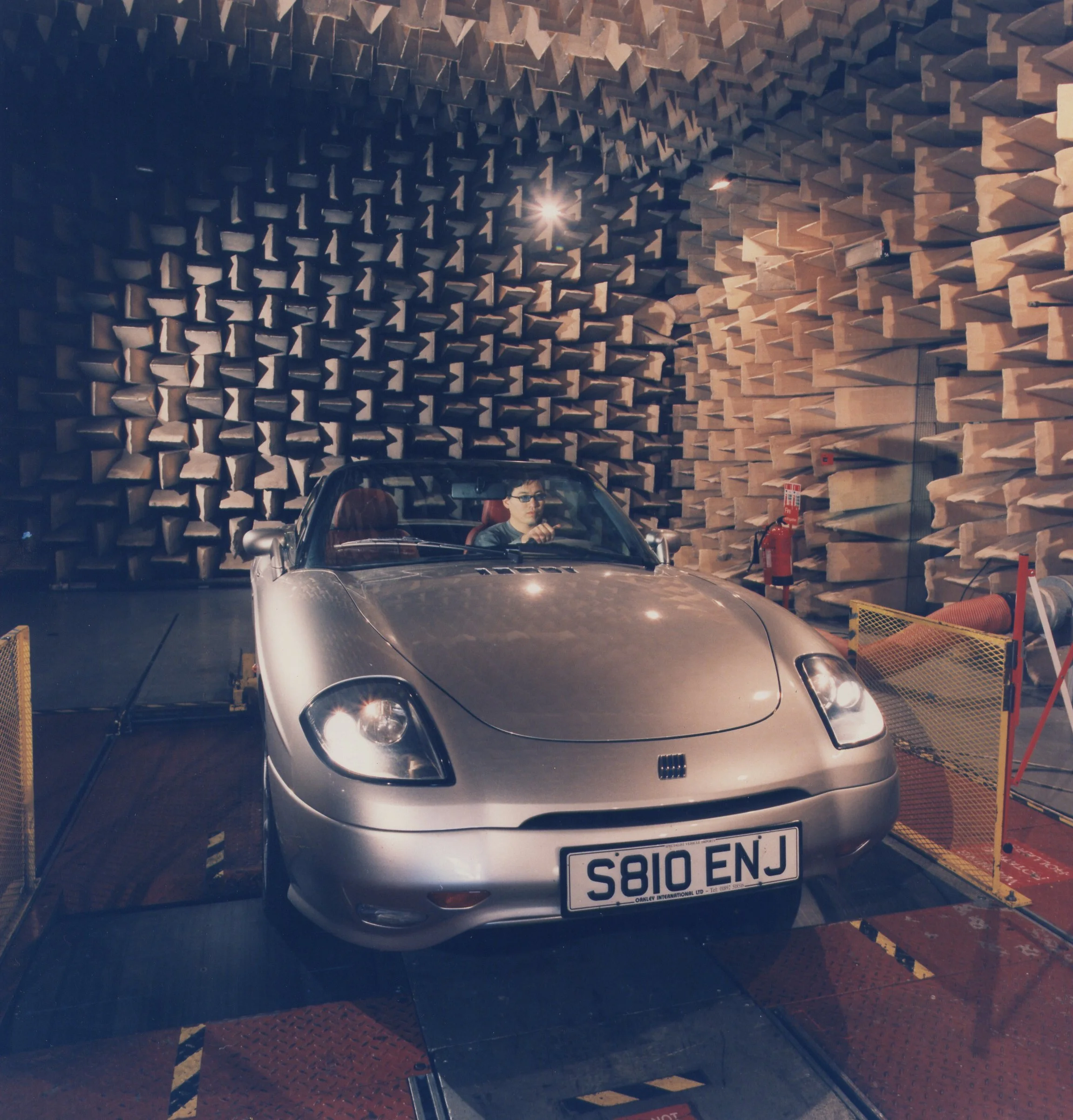
Recording a Fiat for MSR. In the driver’s seat, Sega Europe producer Kats Sato.
Richard Jacques: It has a rolling road, so you can put the vehicle under load and up to a certain amount of revs, and it's sort of soundproofed so it gives a really clean recording. I took a bunch of microphones and equipment from the Sega studio in London, and we drove down with the assistant producer and the main producer in Sega, Europe. And we spent ages recording all the different car sounds in different rev ranges under load. We had binaural head inside the car. We had, I think, eight microphones around the car, a couple on exhaust. We recorded again with the hood up, various positions, and we did some stuff on the high-speed circuit as well. Some of it was usable, but most of the stuff we got from the chamber where we did the main recordings.
James Tocchio: Are you a car enthusiast?
Richard Jacques: Not in the slightest. No. I love racing games, that's for sure. Always have done and still do now. But I'm more a boat person than cars.
James Tocchio: I was going to ask if you have a favorite car.
Richard Jacques: Well, it would have to be probably going back to my gaming days, probably the Toyota from Sega Rally, the Toyota. Was it the Corolla? I forget now. Or the Ferrari from OutRun, you know.
James Tocchio: The Testarossa.
Richard Jacques: Exactly.
James Tocchio: And you worked on OutRun 2, so that’s lucky. But let’s not get sidetracked. Prior to this interview I was looking at the cover art for MSR, the Opel Speedster. I remember when this game came out, I think I was 16 years old, something like that, which in the USA is the time when you get your license. And I was a huge car nerd and I remember seeing this cover and thinking “That is the best car I've ever seen.” And tragically for me, we never got it over in the United States.
Richard Jacques: Oh, did you not?
James Tocchio: They never sold it here.
Richard Jacques: I mean, I used to see a few. It was quite a coup for Sega to get that for the front cover and have it in the game, because it was so brand new, and a very different kind of car. I'd never seen anything like that before. It looks great on the cover.
Richard Jacques: I always wondered who was in the driving seat, because I'm sure it’s one of the producers from Sega Europe. Okay, I'm looking at it now. So yeah, the person driving, I'm not sure. But if you look in the background. There's a silver I think it was a Fiat. I think that is the producer's car, because I remember the registration.
James Tocchio: Oh, that's funny!
Richard Jacques: Yeah. So the producer in London, Kats Sato is his name. I think he's working at Sumo now. Really great guy, and I'm pretty sure that is the car. He had the silver one.
James Tocchio: There's a funny story I’ve read about Kats Sato, maybe you’ve not heard this one. Are you familiar with the story about how he discovered who was developing the Formula 1 games for Sony? They were at a conference, and the game was running, and he wanted to know who was developing it for Sony, so he pulled the power cord for the demo so that when they plugged it back in and it booted up he could have a chance at seeing the name of the company that was working on it. And he found out it was Bizarre Creations, which led to SEGA securing MSR for the Dreamcast.
Richard Jacques: [Laughing] That wouldn't surprise me. Knowing him as I do. He's got an amazing sense of humor, and great businessman and a great producer. I can’t comment on that story either way, but it would certainly sound true of the person I know.
James Tocchio: This may be touchy, but tell us about your mishaps in the car recording chamber.
Richard Jacques: Well, I'll keep it very loose, if I may. There was one. There was a couple of days during recording where I was off sick, and I couldn't make it. Just had some flu bug or something, and I couldn't make it to the recording. And the assistant producer had seen what I was doing, and he was operating the recording stuff, and I had no qualms [about him running things in my absence]. I looked at the list and said, “Oh, we've got these three cars tomorrow, and these three cars on Thursday or whatever. And yeah, don't worry. You'll be fine.”
Richard Jacques: But not really being a car person, as I've mentioned, I didn't realize that one of them had an automatic gearbox, and the only thing I'll say is that when we finished recording, we pushed it a few miles down the road, and it no longer had an automatic gearbox. That's all I will say.
James Tocchio: Can you say which car?
Richard Jacques: I think it was a Mercedes SLK.
James Tocchio: Oh, that’s a cheap one. No big deal.
Richard Jacques: Exactly. Yeah.
James Tocchio: So getting back to the music. You compose 27 songs, plus some menu music. Do you have a favorite song or radio station.
Richard Jacques: Well, that's a good question. I guess in terms of capturing that sort of moment in time, because all the different songs are very loosely based around artists and bands that would have been around at that time. I'd say, one of the London ones, maybe the dance station in London, London Underground FM. I like all the jazz stuff, but that's sort of strewn around between London and some of the radio stations in Tokyo, as well.
James Tocchio: Yeah, the jazz tracks are really impressive. I remember you telling me that when you first got the job at SEGA, they were very impressed with your versatility, and the range of music that you could put together.
Richard Jacques: Yeah, this one was almost the ultimate test, really, because in terms of popular music there's not a lot that wasn't included. So it was a test, and, you know, being as self-critical as I am, I think some songs work better than others, but I think, overall, they all had a certain quality and a certain feel that worked with the game. And yeah, I was happy with the results to be honest. But it was, you know, chopping and changing from dance one minute, rock the next, and then next week we're doing country. And then, the week after we're doing something completely different.
Richard Jacques: Certainly, you had to be on your toes, and I wanted to make sure it was authentic, and the production was up there. So, yeah, it was the ultimate musical test, if you like.
James Tocchio: I want to ask you about some specific songs. Tell me a bit about the song called Sold Out. It is so optimistic and sort of full of life.
Richard Jacques: Sold Out is a play on words of one of my favorite bands and favorite albums, which is a cross between Selling England by the Pound and Seconds Out, which are both Genesis albums. That's why it has a bit of a prog rock feel to it.
Richard Jacques: I suppose that was a bit of my personal tribute to Genesis, which is a band I've followed since I was a kid, and I remember discovering their music. I was probably around 11 or 12 years old. I was having a piano lesson, and in the next door room my piano teacher's son was a drummer, and he was playing along to a Genesis song called Turn It On Again, which is a great song from the eighties, I guess, and it had this very strange time signature. I think it's in 13 8 time signature, which is very unusual. So you have this kind of regular beat, and then it sort of skips at the end of each measure, and then the same again, and I was fascinated listening to this, and I was trying to do my piano lesson, but I had no interest at all. I was just really interested in this music, and that's where I discovered Genesis. And then I went back to some of their earlier catalogue from the early seventies when they formed, and their keyboard player, Tony Banks is such a genius of harmony and chords. Their chord changes when they go from a verse to a chorus or into a new section, just has this huge lift, and that was something I was consciously trying to do with that track. I wasn't trying to copy Genesis or thinking I'm as good as that band who, I think, are amazing, but I just really appreciate what they did for me as a young musician and as a fan of their music. So it was a conscious decision to try and at least give a tip of the hat to them. If you see what I mean.
James Tocchio: Yeah, that song. There's just something about the way it's flowing, and feeling great, and then it just changes. It shifts, which is perfect for a racing game, because it's like a downshift and we start accelerating or surging forward. It's just so perfect. Do you remember Long, Long Road? I feel like you were having a little fun with that one.
Richard Jacques: I mean, I was having some gentle fun. I certainly wasn't trying to be disrespectful, because I like that kind of music, and it does give me a smile, and I do think there's a certain element of humor that the country artists put in when they're doing a song like that, and because it's a racing game, I didn't want it to be too serious.
Richard Jacques: But yeah, of course, I wanted to try and capture the flavor of what genres are all about and what their foundations are. But yeah, with Long, Long Road I tried to tell this quite amusing tale and I had a bit of fun with it as well.
James Tocchio: And then Let's Get It On Tonight has a totally different flavor.
Richard Jacques: It was around that time when Will Smith was pretty big both over here and in the US, so I would call it hip hop, yes, but it's got more of a party vibe to it, and I've always liked that kind of stuff. I tried to do it in a way that I thought if I was creating that song, if I was that artist, that's the invented artist on the radio, and I would have been sampling a 1970s record, and then add some hip hop loop, drum loops, and stuff over the top. What would that sound like? So then I had to try and create a hook from a seventies record and then build on top of it. So I kind of had to deconstruct it and build it ground up.
James Tocchio: I think what is most impressive to me about this soundtrack is the versatility that's on display, and just how effective each song is at capturing a mood and a vibe. Even the main menu music is really interesting. You could describe that particular song as simple, but I'm sure it's deceptively simple.
Richard Jacques: I think that's probably the last one I wrote, because I don't know whether it was a decision about whether we needed menu music, how long the menus are going to last, and I thought, “Well, I'll write a track.” And I just wanted that energy when you fired up the console, right from the beginning to have that energy. It's a hard house track I suppose, and it's got the my original TV 303 bass line doing all the squelchy sounds. It's quite a simple hook, but it works. It pushes things forward, and that's what I was trying to do with those rhythms that I was playing around with in that track.
James Tocchio: Can you talk a little bit about the vocalists that you use? I know that TJ Davis is featured in many of the songs, but I know there's other vocalists as well.
Richard Jacques: Yeah.
James Tocchio: What was like to reunite with with TJ Davis after you worked together on Sonic.
Richard Jacques: There were quite a few vocalists, maybe six or seven. I’d previously worked with TJ on Sonic R, which was released in 1997. So when this project came up, I wanted to get her involved, and knowing that she is also a very versatile singer. I knew that she's got a great rock voice, and she's got a great pop voice as well. I'd already made a little mark by my list of tracks, saying which would be good for her. Got in touch, and she was very keen to come back.
At that time she was in a record contract with a record label, so we weren't allowed to use her name, so she went under the name of Helena Davidson. And she did maybe five or six songs. Some of the dance stuff, one of the jazz funk tracks and a couple of the rock tracks she did, and some of the pop stuff as well, because she's very good at changing her voice to suit the style. So when she's singing the pop stuff, she has a very kind of younger, more whispery voice, and then she can really belt out the rock numbers as well, because she's got a very strong, powerful voice. And then, yeah, some of the other singers. Stephen Stapp was a UK singer who did, I think, two tracks.
And then we had MC Momo, as he's known, doing the raps. And Gavin Skeggs, who did the Disco. Everyone was picked for their vocal sound and style, coupled with the tracks I was writing to make sure the fit was working.
James Tocchio: What was the most challenging style for you to compose?
Richard Jacques: I think for me some of the rock stuff for one of the San Francisco radio stations, because it doesn't come naturally to me, and I had to work extra hard to make sure it was on point, both musically and lyrically. Apart from that, the others were fairly straightforward, and I was pretty comfortable on all the others.
James Tocchio: What was the most fun radio station to compose for?
Richard Jacques: Oh, that is a tough question, I would say West Central 1, which is a sort of pop station based on a couple of radio stations in London, because you would have an all female sort of vocal pop group, and then you would have, you know, something a bit more on the Brit pop edge, and then you'd have some, maybe something a bit dancey or a bit disco. And that was a lot of fun because I grew up listening to all that kind of stuff. And it's a very commercial radio station. Yeah, they don't play anything too edgy. But it it was quite fun trying to just get a bit more out of it, taking those tracks a little bit further than maybe they would in real life.
James Tocchio: When was the last time you listened to this soundtrack?
Richard Jacques: There's a Youtuber, a young lady, and she played the whole thing and reacted to every song, and I listened. It was interesting, seeing her reaction, and I think she might be a musician because she was talking about some of the jazz stuff and some of the brass. But that was nice, just seeing someone literally react in real time to what they were hearing, and I was prepared for some very honest reactions, shall we say? But it was good to hear it again. Some of the jazz stuff I really enjoy. I was unpacking some old archive boxes. And I found the original sheet music. So I'm going to make sure that's all scanned and digitized.
James Tocchio: This soundtrack doesn't have an official release, correct?
Richard Jacques: That's something I'm sure I could do myself with Sega's approval. I'm sure they would be open to it. It would be nice to have a physical, maybe a low run vinyl or CD release, and maybe to get it on streaming services. I'm sure a small number of vinyls or CDs would be suitable. It'd be interesting to see if people are interested. I do read a lot of comments, and you know that it would be nice to get it out there. I'd love to remix some of the tracks and just bring them up to date a little bit. There's a few things where I can hear the odd imperfection, and if I was allowed to do that, then I would definitely re-release it.
James Tocchio: What’s the feeling when you see that people are still really loving the things you’ve created 20 or 25 years after you made them?
Richard Jacques: Yeah, it is amazing. And it's something I never ever expected. As far as I'm concerned, I was just doing the best job I could to make the best music I could for the game I was working on at the time, and I try not to think about reviews or press or the games reception, because I've got no control over that.
What I find very humbling is there's a whole new generation of fans for this soundtrack and some of my other soundtracks that weren’t yet born when I was writing them, so for them to be a fan of the music, and then, they might find an emulator, or an old Dreamcast, or Saturn console to play the game, to join the dots and see what the experience is like, is great. And if they find the music alone is a very pleasurable experience. It blows my mind, and I'm grateful to people for listening. It always puts a smile on my face.
James Tocchio: That's perfect.